Slow-rotating computed tomography (CT) devices are prone to motion artifacts due to long scan times. These devices are commonly used in interventional procedures or radiotherapy involving cone-beam CT (CBCT). While several motion correction strategies have been proposed, accurately reconstructing motion-corrupted images directly from projection data remains challenging due to strong nonconvex coupling between motion parameters and images. In this work, we propose a method to mitigate motion artifacts in slow-rotation CT imaging. We tackle the challenge of nonconvexity with an alternating proximal algorithm that benefits from convergence guarantees while jointly estimating motion and image information. We show that a rigid, piecewise-constant motion model that captures typical patient motion patterns provides stable estimation. A multiscale discrete search strategy accelerates motion estimation to move towards real-time motion correction. Experimental results on a real slow-rotation CT dataset demonstrate that the proposed method effectively estimates rigid motions, while significantly improving reconstruction quality over traditional FBP, iterative strategies, and a recent learning-based motion correction method.
Oral
BREIT: A Framework for Brain Stroke Reconstruction using Multi-Frequency 3D EIT
Djahid Abdelmoumene, Ishak Ayad, Maï K. Nguyen, and Christian Daveau
In Proceedings of the International Conference on Medical Image Computing and Computer Assisted Intervention (MICCAI), 2026
Multi-Frequency Electrical Impedance Tomography (MF-EIT) is a non-invasive, low-cost modality that reconstructs electrical property distributions from boundary voltages. For stroke imaging, progress in 3D deep-learning reconstruction is limited by the lack of large-scale datasets with paired ground-truth (GT) volumes and by non-standardized pipelines for data generation, simulation, and evaluation. We introduce BREIT, a modular framework for 3D MF-EIT stroke reconstruction providing: (i) a neuroimaging-to-EIT pipeline that converts CT/MRI into frequency-dependent GT admittivity volumes; (ii) a self-contained Python 3D Complete Electrode Model (CEM) forward solver for simulating MF-EIT voltages; and (iii) a 3D D-bar implementation supporting non-uniform electrode layouts. Building on BREIT, we propose dFNO-bar, which integrates Fourier Neural Operators into D-bar by learning a mapping from scattering data t(ξ) to conductivity σ(x)=\Re{γ}. We evaluate dFNO-bar against D-bar, Deep D-bar, and Gauss–Newton reconstructions on UCLH-matched synthetic data, and observe higher brain SSIM with comparable CC across noise settings.
2024
UnWave-Net: Unrolled Wavelet Network for Compton Tomography Image Reconstruction
Ishak Ayad, Cécilia Tarpau, Javier Cebiero, and Mai K. Nguyen
In Proceedings of the International Conference on Medical Image Computing and Computer Assisted Intervention (MICCAI), 2024
Computed tomography (CT) is a widely used medical imaging technique to scan internal structures of a body, typically involving collimation and mechanical rotation. Compton scatter tomography (CST) presents an interesting alternative to conventional CT by leveraging Compton physics instead of collimation to gather information from multiple directions. While CST introduces new imaging opportunities with several advantages such as high sensitivity, compactness, and entirely fixed systems, image reconstruction remains an open problem due to the mathematical challenges of CST modeling. In contrast, deep unrolling networks have demonstrated potential in CT image reconstruction, despite their computationally intensive nature. In this study, we investigate the efficiency of unrolling networks for CST image reconstruction. To address the important computational cost required for training, we propose UnWave-Net, a novel unrolled wavelet-based reconstruction network. This architecture includes a non-local regularization term based on wavelets, which captures long-range dependencies within images and emphasizes the multi-scale components of the wavelet transform. We evaluate our approach using a CST of circular geometry which stays completely static during data acquisition, where UnWave-Net facilitates image reconstruction in the absence of a specific reconstruction formula. Our method outperforms existing approaches and achieves state-of-theart performance in terms of SSIM and PSNR, and offers an improved computational efficiency compared to traditional unrolling networks.
Oral
QN-Mixer: A Quasi-Newton MLP-Mixer Model for Sparse-View CT Reconstruction
Ishak Ayad, Nicolas Larue, and Mai K. Nguyen
In Proceedings of the IEEE/CVF Conference on Computer Vision and Pattern Recognition (CVPR), 2024
Inverse problems span across diverse fields. In medical contexts, computed tomography (CT) plays a crucial role in reconstructing a patient’s internal structure, presenting challenges due to artifacts caused by inherently ill-posed inverse problems. Previous research advanced image quality via post-processing and deep unrolling algorithms but faces challenges, such as extended convergence times with ultra-sparse data. Despite enhancements, resulting images often show significant artifacts, limiting their effectiveness for real-world diagnostic applications. We aim to explore deep second-order unrolling algorithms for solving imaging inverse problems, emphasizing their faster convergence and lower time complexity compared to common first-order methods like gradient descent. In this paper, we introduce QN-Mixer, an algorithm based on the quasi-Newton approach. We use learned parameters through the BFGS algorithm and introduce Incept-Mixer, an efficient neural architecture that serves as a non-local regularization term, capturing long-range dependencies within images. To address the computational demands typically associated with quasi-Newton algorithms that require full Hessian matrix computations, we present a memory-efficient alternative. Our approach intelligently downsamples gradient information, significantly reducing computational requirements while maintaining performance. The approach is validated through experiments on the sparse-view CT problem, involving various datasets and scanning protocols, and is compared with post-processing and deep unrolling stateof-the-art approaches. Our method outperforms existing approaches and achieves state-of-the-art performance in terms of SSIM and PSNR, all while reducing the number of unrolling iterations required.
2023
A deep-learning based algorithm for image reconstruction in Compton tomography
Ishak Ayad, Cécilia Tarpau, Javier Cebeiro, and Mai K Nguyen
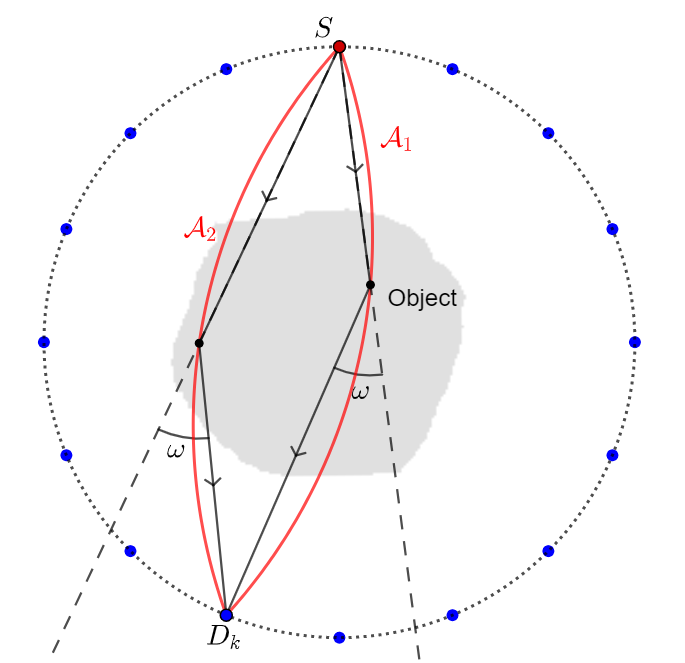
In this paper we study the applications of deep-learning to the problem of image reconstruction in Compton scatter tomography, a field where deep-learning techniques are still unexplored. Particularly, we focus on a new design with uncollimated detectors that simplifies some previous configurations of Compton scanners. The system inherits attractive advantages such as non-moving components and the ability to combine with other imaging modes. Since there is no an analytic inverse formula for image reconstruction, we developed a GAN based algorithm that provides an efficient mapping between data and image domains. We compare our method against several algorithmic approaches and show that high quality image reconstruction is feasible. Results encourage further research in the application of deep-learning reconstruction techniques in Compton scatter tomography, particularly when inverse reconstruction formulas are unknown.
2022
Tomographic reconstruction from sparse-view and limited-angle data using a generative adversarial network
Ishak Ayad, Cécilia Tarpau, Javier Cebeiro, and Mai K. Nguyen
In IEEE International Conference on Signal-Image Technology & Internet-Based Systems (SITIS), 2022
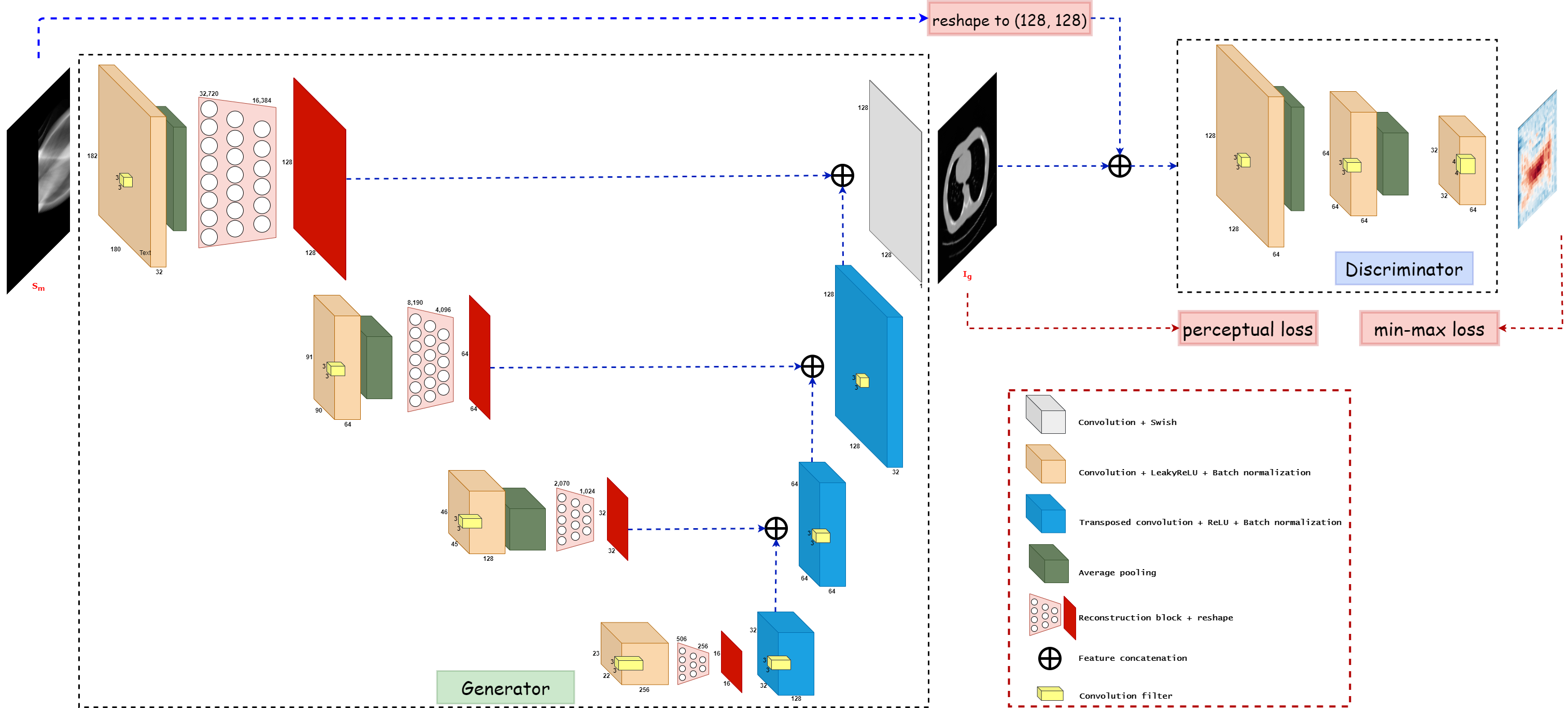
Limited-angle and sparse-view computed tomography have been widely used to shorten the acquisition time in medical imaging and to offer the possibility of scanning large objects. However, this is a severely ill-posed inverse problem due to missing data. In these scenarios, the well-known filtered back-projection reconstruction technique exhibits severe artifacts and degradation. Recently, deep learning methods have demonstrated impressive performance in computer vision (denoising, classification, etc.) but it frequently fails to solve both limited-angle and sparse-view reconstruction. Inspired by the high performance of GAN-based image-to-image translation methods, we investigate a patchGAN as a solution to the reconstruction problem mapping data (Radon space) into the image domain. The generator is made of a V-net where the reconstruction in the sense of a least-squares minimization is carried out at different scales in the encoder path and linked with the decoder path by skip connections. The discriminator uses both information from the image and projection data domains. The proposed method gives promising reconstruction results from data acquired with a limited angular range covering only 110 degrees (instead of 180 degrees), as well as for sparse-view data with 10 degrees of sampling step. Moreover, different reconstruction results show that the method is able to reconstruct images from sparse and limited angular range data at the same time.
Tomographic image reconstruction from incomplete data via a hybrid GAN
Limited data tomographic reconstruction has been widely used in medical imaging to reduce the radiation dose or shorten the data acquisition time. This is achieved by truncating the scanning angular range or increasing the angular sampling rate. However, the use of classical reconstruction methods with such incomplete data involves severe streaking artifacts, blurred edges, distorted boundaries, contrast loss, and decreased intensities in the reconstructed images. In this work, we propose a generative adversarial network made of a V-net generator with modified skip connections that simulates the algebraic reconstruction and a discriminator combining both information from the image and projection domains which only penalizes structure at the scale of image patches. The proposed method obtains promising results for data coming from both limitedangle and sparse-view projections, that is, data acquired from an angular range of 90 degrees and an angular sampling step of 10 degrees.
2021
Deep morphological network-based artifact suppression for limited-angle tomography
Ishak Ayad, Cécilia Tarpau, Mai K Nguyen, and Son Vu
In Proceedings of the International Conference on Image Processing and Computer Vision (IPCV), 2021
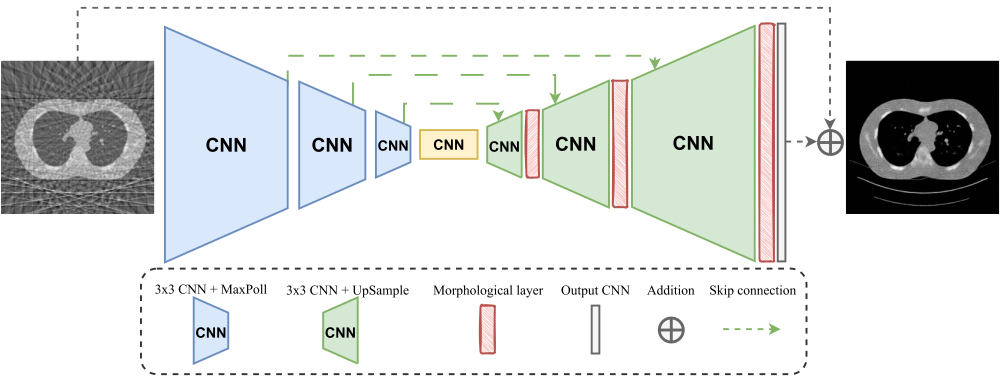
Computed tomography has been widely used in biomedical and industrial applications. The well-known filtered back-projection algorithm, probably the most used reconstruction technique, fails when the angular range used for data acquisition is not sufficient. As a consequence, reconstructions exhibit artifacts. In order to eliminate these artifacts, we propose in this article a new deep learning approach based on a U-net architecture which includes a morphological operation. This operation of mathematical morphology allows us to capture better some non-linear properties of the object to reconstruct. The proposed method provides good results for angular ranges of 170, 150, 130 and even 110 degrees. To the best of our knowledge, it is the first time a limited-angle artifact suppression method works with 110 projections.
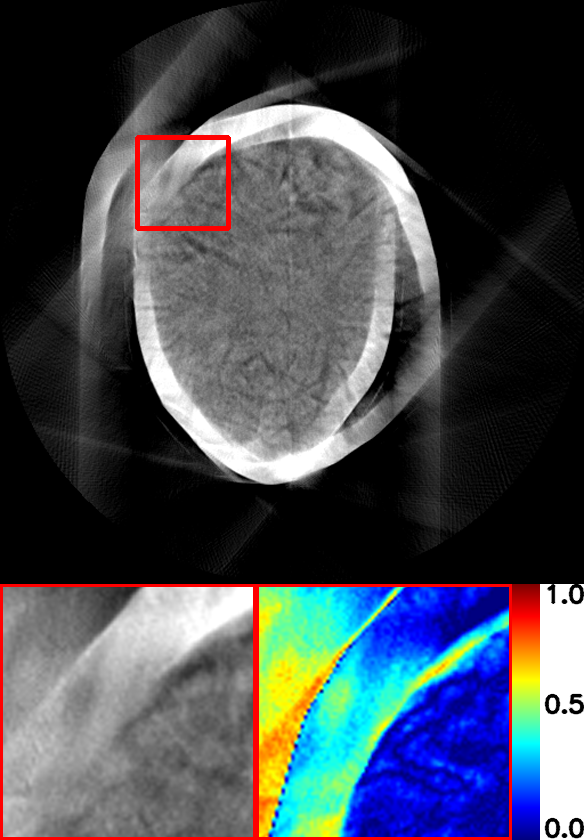 A Rigid Motion Compensated Optimization Approach for Medical Image ReconstructionIn 34th European Signal Processing Conference (EUSIPCO 2026), 2026
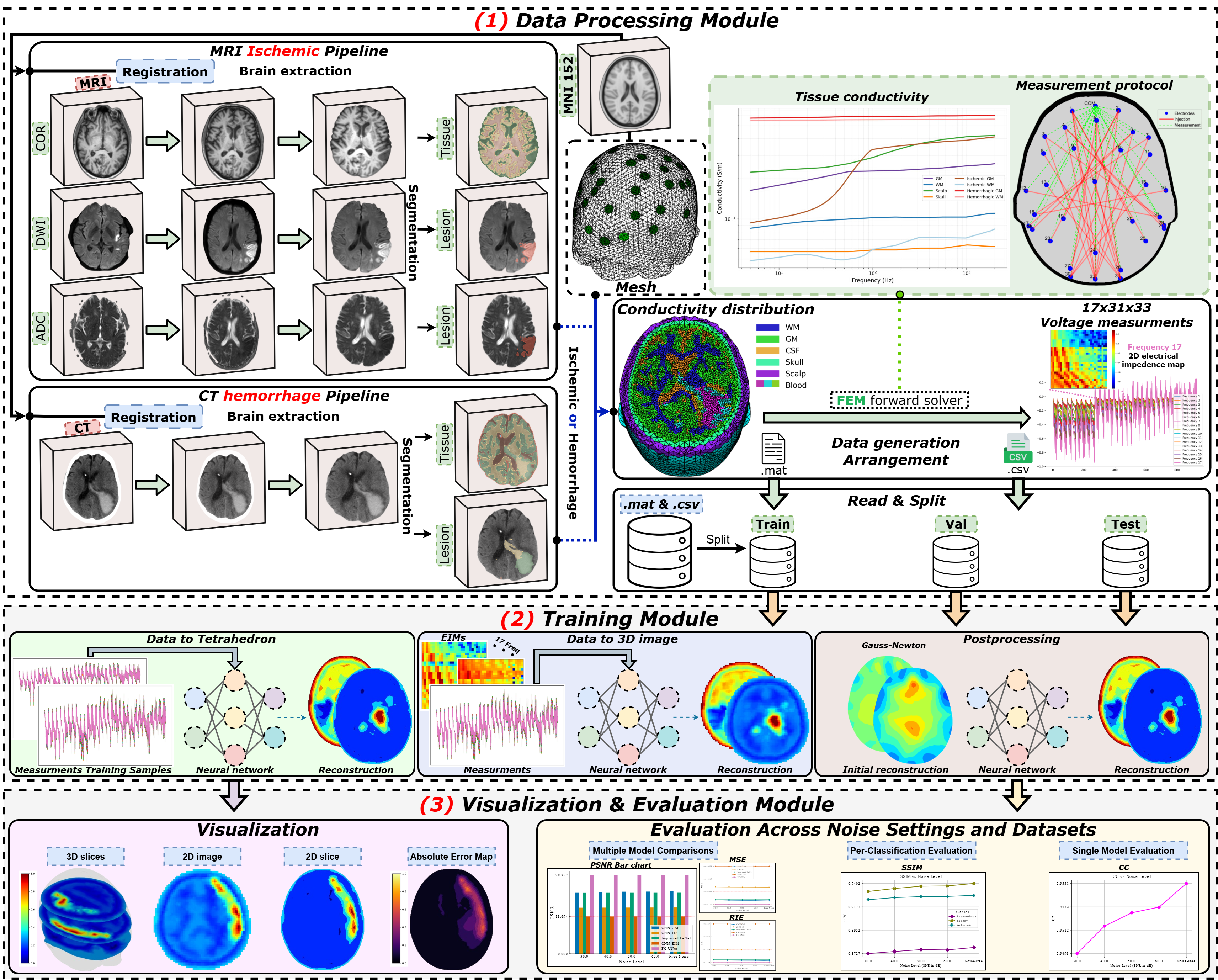 BREIT: A Framework for Brain Stroke Reconstruction using Multi-Frequency 3D EITIn Proceedings of the International Conference on Medical Image Computing and Computer Assisted Intervention (MICCAI), 2026

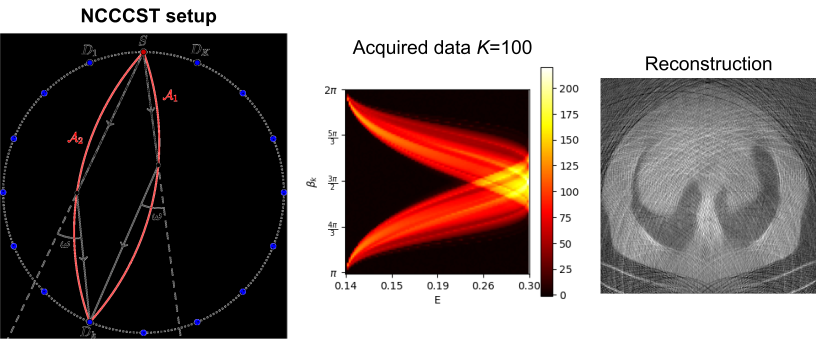 UnWave-Net: Unrolled Wavelet Network for Compton Tomography Image ReconstructionIn Proceedings of the International Conference on Medical Image Computing and Computer Assisted Intervention (MICCAI), 2024
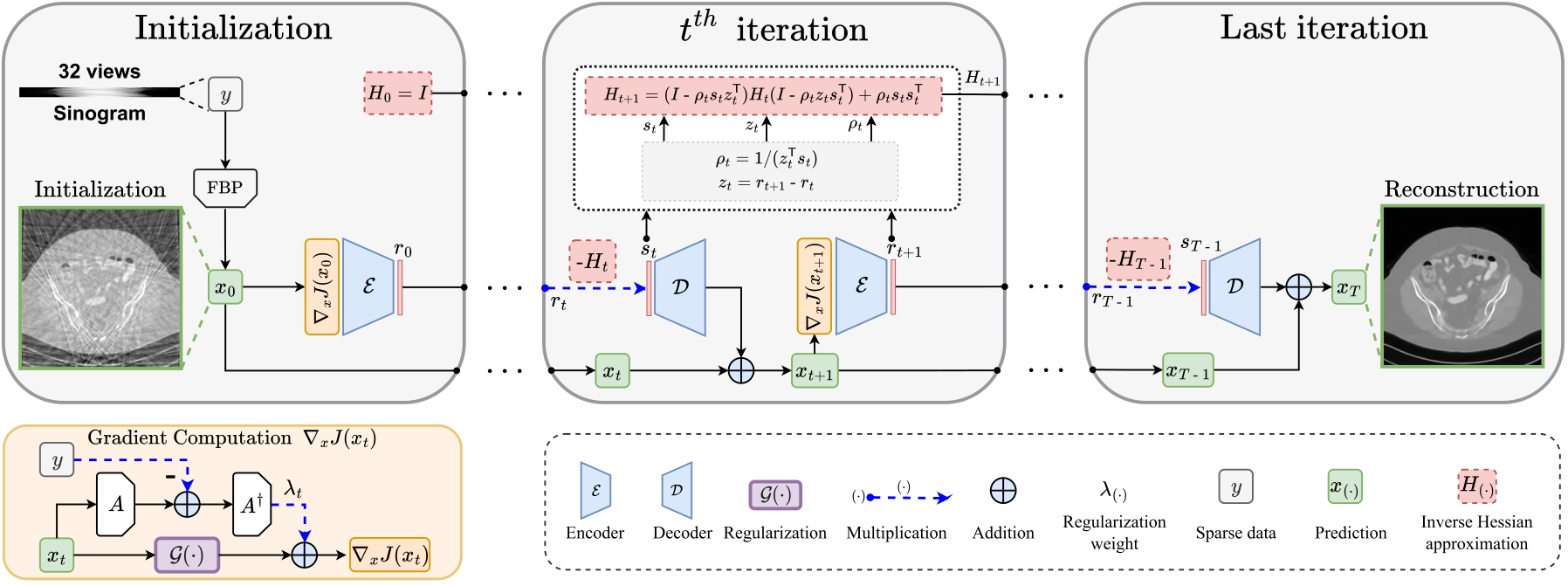 QN-Mixer: A Quasi-Newton MLP-Mixer Model for Sparse-View CT ReconstructionIn Proceedings of the IEEE/CVF Conference on Computer Vision and Pattern Recognition (CVPR), 2024
 A deep-learning based algorithm for image reconstruction in Compton tomographyIn IEEE IPTA, 2023
 Tomographic reconstruction from sparse-view and limited-angle data using a generative adversarial networkIn IEEE International Conference on Signal-Image Technology & Internet-Based Systems (SITIS), 2022
 Deep morphological network-based artifact suppression for limited-angle tomographyIn Proceedings of the International Conference on Image Processing and Computer Vision (IPCV), 2021